


The Science of Full Range of Motion vs. Partial Reps: What Actually Builds Muscle?
You've probably heard both arguments at the gym. One person swears by perfect, full-range squats that hit true depth. Another claims half reps let them load more weight and spark better gains. So which approach actually works?
Here's what the research says about full range of motion versus partial reps, and how FitnessAI uses this science to program your workouts for measurable results.
What Full Range of Motion Really Means
Full range of motion (ROM) means moving a joint through its complete functional arc during an exercise. For a squat, that's descending until your hip crease drops below your knee. For a bench press, it's lowering the bar to your chest before pressing back up.
When you train with full ROM, you engage more muscle fibers across the entire length of the muscle. Research consistently shows this leads to greater muscle hypertrophy and improved flexibility compared to partial reps. A study in the Journal of Strength and Conditioning Research found that full ROM training produced significantly more muscle growth than partial ROM, particularly when muscles are loaded in their stretched position.
The reason? Muscles grow best when they're under tension through their full lengthened state. That deep stretch at the bottom of a Romanian deadlift or full extension at the top of a shoulder press triggers mechanical tension and metabolic stress, two primary drivers of muscle hypertrophy.
.png)
When Partial Reps Actually Make Sense
Partial reps aren't completely useless. They have legitimate applications in strength training.
Partial reps let you overload specific portions of a movement with heavier weight than you could handle through full ROM. This can strengthen sticking points and build neural confidence with heavier loads. For example, if you struggle at the top of your bench press lockout, board presses or pin presses can help.
They're also useful for rehabilitation or working around injuries. If full ROM causes pain, strategically limited ROM can keep you training safely while you recover.
The problem happens when people default to partial reps because they're easier or allow for heavier weight that looks impressive. Quarter squats might let you pile on plates, but they won't build the same strength, muscle mass, or joint integrity as full-depth squats.
Progressive Overload: The Missing Piece
Here's what most people miss: whether you use full ROM or partial reps, progressive overload is what actually drives adaptation. That means gradually increasing the training stimulus over time, more weight, more reps, or more sets.
The challenge? Applying progressive overload correctly while maintaining proper form through full ROM takes precision. Load too much weight and your form breaks down. Progress too slowly and you leave gains on the table.
This is exactly what FitnessAI solves.
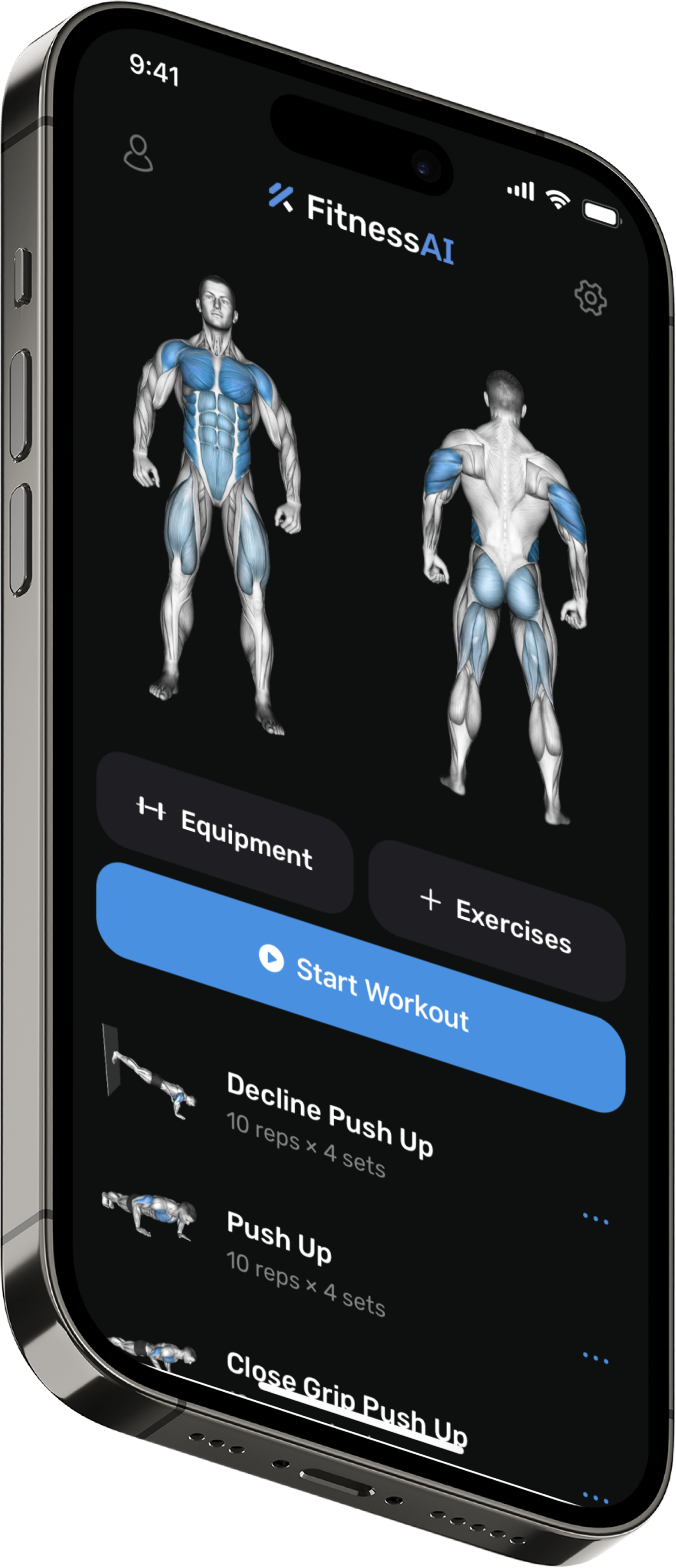
How FitnessAI Optimizes Your Range of Motion and Progressive Overload
FitnessAI's algorithm analyzes millions of workout data points to build personalized strength programs that maximize progressive overload while maintaining movement quality.
When you log a set, the app tracks your performance over time and adjusts your next workout accordingly. If you're consistently hitting your prescribed reps with solid form, it progressively increases the load. If you're struggling, it recalibrates to keep you in the optimal training zone, challenged but not compromised.
The app emphasizes full ROM compound exercises proven to drive strength and hypertrophy: squats, deadlifts, rows, presses, and pull-ups. Because it adapts to your available equipment, whether you're in a fully equipped gym or training with just dumbbells at home, you get effective programming regardless of your setup.
Ready to train smarter, not harder? Download FitnessAI today and get your first personalized strength workout built on proven progressive overload principles. No guesswork, just results.
Full ROM Builds More Muscle: What the Science Shows
Multiple studies confirm full range of motion training superiority for muscle growth:
- Muscle fiber recruitment: Full ROM activates more motor units throughout the entire muscle length
- Time under tension: Complete reps increase total work performed, enhancing hypertrophic stimulus
- Flexibility and mobility: Training through full ROM improves joint health and functional movement patterns
- Injury prevention: Balanced strength through complete ranges reduces compensation patterns and imbalances
A 2019 study in the European Journal of Sport Science found participants using full ROM gained 2x more muscle thickness compared to those using partial ROM over 10 weeks of training. The difference? Full ROM created superior mechanical loading in the stretched muscle position.
Unless you have a specific reason to use partial reps, like targeting a sticking point or managing an injury, full range of motion should be your training default.
The Weight Selection Problem (And How to Fix It)
Here's the catch: full ROM only works if you're using appropriate weight. Loading the bar so heavy that you sacrifice depth or range defeats the entire purpose.
This is why most people plateau. They either:
- Use too much weight and unconsciously shorten their ROM
- Use too little weight and fail to create enough stimulus for adaptation
- Progress randomly without a systematic plan
FitnessAI eliminates this guesswork. The algorithm selects weights that challenge you without forcing compensation patterns or partial reps. Over weeks and months, you'll lift progressively heavier loads while maintaining quality movement, the exact combination that builds real strength.
Stop spinning your wheels. Start your free trial of FitnessAI and experience what happens when your training is optimized by data, not guesswork.
.png)
Practical Application: What This Means for Your Training
If you want results, prioritize these principles:
Control the eccentric phase. The lowering portion of every lift is where significant muscle damage and growth occur. Don't drop weights, lower them with control.
Move through your full available range. If you can't hit proper depth on a squat, address ankle and hip mobility limitations, don't just default to half reps and call it good enough.
Apply progressive overload systematically. Use FitnessAI to track performance and ensure you're advancing your training variables correctly. The app adjusts your sets, reps, and weights so you're always progressing without stalling or overreaching.
Prioritize compound movements. Exercises like squats, deadlifts, bench press, rows, and overhead press deliver the most bang for your buck when performed through full ROM with progressive loading.
Your Next Workout Starts Here
The science is clear: full range of motion training builds more muscle, creates balanced strength, and improves long-term joint health compared to partial reps. But knowing the science isn't enough, you need to apply it consistently with proper progressive overload.
That's exactly what FitnessAI does. The app takes proven strength training principles and automates the programming so you show up, do the work, and see results.
Download FitnessAI now and get your first AI-generated workout free. Your personalized strength program is waiting, built on millions of data points and designed to make you stronger, starting today.
Alyssa Gonzalez
