


Are You Too Old to Start Lifting? Why Strength Training Has No Starting Age
At some point, most people wonder if they’ve missed their window to get in shape.
Maybe you’re 30 and noticing that recovery takes longer than it did at 22. Maybe you’re closing in on 40 with a packed calendar, and starting a strength routine feels like something you should have figured out years ago. Or maybe you’ve been waiting for life to slow down first.
Here’s the good news: you’re not too old to start strength training. Not at 30, not at 40, and not at 60 or beyond.
Research consistently shows that adults can build muscle and get stronger well into later life. What matters isn’t when you start. It’s following a program that meets you where you are and progresses from there. And it doesn’t take two hours in the gym.
Is There an Age Limit for Building Muscle?
No. Your muscles keep responding to resistance training throughout adulthood. The pace of growth and recovery may change, but the process stays the same: challenge a muscle, and your body adapts by making it stronger and, over time, bigger.
That process, called muscle hypertrophy, isn’t reserved for people in their twenties. Research published in Frontiers in Physiology has shown that older adults can improve muscle size and strength through resistance training, even when they start later in life.
Your training needs may shift with age. Your ability to make progress doesn’t disappear.

Can you build muscle after 30?
Absolutely. For most healthy adults, turning 30 doesn’t trigger a sudden drop in muscle-building ability. Your thirties can actually be a great time to start, since you likely have a clearer sense of your schedule, your goals, and what you’ll realistically stick with.
Consistent training, appropriate challenge, enough protein, and adequate recovery matter far more than your birthday.
Can you start lifting weights at 40 or 50?
Yes, and the payoff goes well beyond appearance. Lifting in your forties and fifties helps maintain muscle, supports bone health, and makes everyday tasks like carrying groceries or climbing stairs easier.
You don’t need to catch up to someone who started at 18. You just need a starting point that makes sense for you.
What Actually Happens to Your Muscles as You Age?
Age-related muscle loss is real, but it’s often misunderstood.
Starting around mid-adulthood, people can gradually lose muscle mass, especially if they aren’t active. This is associated with sarcopenia, the age-related decline in muscle mass and strength. But losing muscle with age isn’t the same as being unable to build it.
A few factors drive these changes:
- Less activity: Busy schedules mean fewer chances to challenge your muscles.
- Changes in muscle protein synthesis: Older muscles may need a stronger training or nutritional stimulus to get the same response.
- Hormonal shifts: These can affect muscle maintenance, recovery, and body composition.
- Too little protein: Without enough of it, maintaining and building muscle gets harder.
- Recovery demands: Sleep, stress, and training volume all affect how well you bounce back.
Resistance training directly addresses several of these. You can’t stop aging, but you can give your muscles a reason to stay strong.
Why Strength Training Matters More as You Get Older
Most people start lifting to look different: build some muscle, lose some fat, feel better in their clothes. Those are great goals. But some of the most valuable benefits become more important with age.
1. It helps preserve muscle mass
Muscle is use-it-or-lose-it tissue. Regularly challenging it gives your body a reason to keep it, which supports staying active and independent as you get older. You don’t need to become a powerlifter. You just need enough resistance to encourage adaptation.
2. It supports bone health
Resistance exercise places mechanical stress on bones, which helps keep them strong. That matters more as bone density naturally changes with age. Lifting works best as part of a broader approach that includes good nutrition and other weight-bearing activity.
3. It supports metabolic health
Muscle plays a major role in how your body uses glucose. Regular strength training can improve insulin sensitivity and support healthy blood sugar regulation. It also helps you hold on to lean mass during weight loss, which is useful if you want to lose fat without losing strength.
Lifting doesn’t automatically produce fat loss. Nutrition, activity, and overall energy balance still matter. But strength training helps protect the muscle you have while your body composition changes.
4. It makes everyday life easier
This one doesn’t get enough credit. Being stronger makes lifting luggage, moving furniture, and getting up off the floor feel easier. You may not notice it in the mirror, but you’ll notice it when something that used to feel hard suddenly doesn’t.

Is It Harder to Build Muscle After 30 or 40?
It can get more challenging with age, especially later in adulthood, but meaningful progress stays within reach.
One reason is anabolic resistance, where aging muscles become less responsive to the signals that stimulate muscle protein synthesis. This tends to matter more in older adulthood. Nothing dramatic happens on your 30th or 40th birthday.
The answer isn’t necessarily training harder. It’s training more deliberately:
- Use weights that challenge you without compromising technique.
- Gradually increase the demands of your workouts.
- Eat enough protein to support repair and growth.
- Allow enough recovery between demanding sessions.
- Stick with a routine instead of constantly starting over.
This is where progressive overload becomes especially important. Rather than guessing when to add weight or reps, it helps to follow a program that responds to what you can actually do.
FitnessAI does this by using your workout performance to adjust recommended weights, reps, and sets over time. If you complete your prescribed reps, the app uses that performance to guide future increases. If your performance or recovery suggests you need a different approach, your training adjusts accordingly.
The goal isn’t to lift heavier every workout. It’s to make each workout appropriate for the progress you’re making.
How to Start Strength Training at Any Age
You don’t need an elaborate plan. In fact, one of the biggest beginner mistakes is trying to do too much before building consistency. Here’s a practical way to begin.
Step 1: Start with two or three workouts per week
Two or three full-body sessions a week give beginners an effective foundation. The American College of Sports Medicine recommends resistance training at least twice weekly for most adults, adjusted to individual ability and goals.
Pick a schedule you can keep. Two consistent workouts are more useful than five ambitious ones you can’t repeat.
Step 2: Focus on basic movement patterns
You don’t need dozens of exercises. A balanced beginner routine covers five basic movement patterns:
- Squat: Chair squat, goblet squat, or leg press
- Hip hinge: Glute bridge or dumbbell Romanian deadlift
- Push: Wall push-up or chest press
- Pull: Seated row or resistance band row
- Core: Dead bug, bird dog, or modified plank
Machines, dumbbells, resistance bands, and bodyweight exercises can all be effective. Choose movements you can perform comfortably and with control. There’s no requirement to start with a barbell.
Step 3: Choose a manageable starting weight
“How heavy should I lift?” depends on your current strength and the exercise. A good starting point: pick a weight you can lift for about 8 to 12 controlled reps while feeling like you could do two or three more with good technique.
If you could easily do 20 reps, the weight is probably too light. If you can’t control the movement, it’s probably too heavy. For beginners, learning the movement comes first.
FitnessAI’s guided exercise videos show how each exercise should be performed, while its personalized workout recommendations give you a starting structure based on your experience and available equipment. You still need to pay attention to how movements feel, but you don’t have to build a program from scratch.
Step 4: Progress gradually
Once your starting weights feel manageable, raise the challenge in small ways. You might add a rep or two, increase the weight slightly, improve your range of motion, move with better control, or add a set when appropriate. You don’t need to change everything at once.
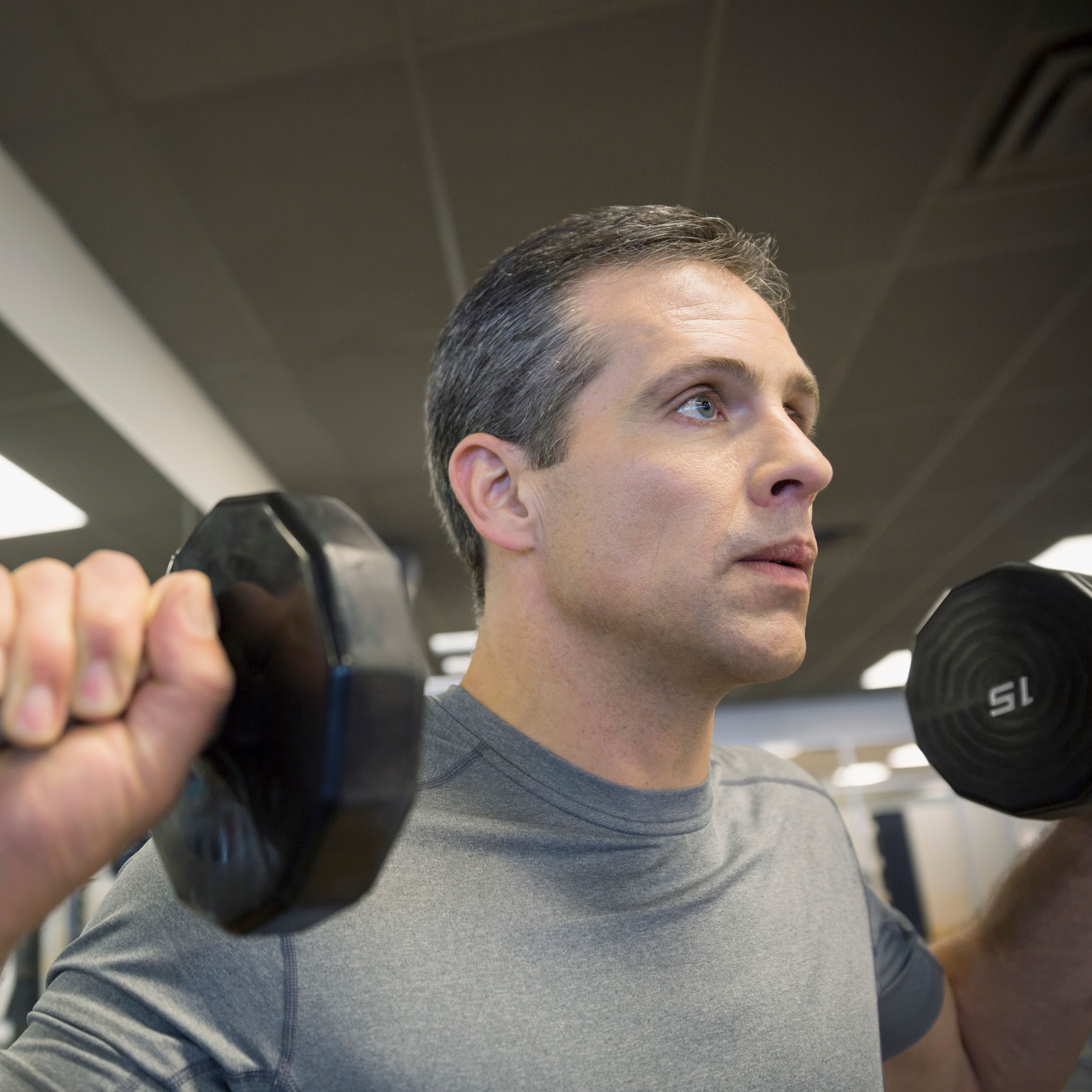
Say you start a dumbbell chest press with 15-pound dumbbells for three sets of eight. Over several workouts, you work up to three sets of 12. Once you can complete those with good technique, you might move to 20-pound dumbbells for fewer reps.
That’s progressive overload: small, measurable increases that compound over time.
FitnessAI helps manage this by using your logged workouts to recommend future weights, reps, and sets. Instead of wondering whether you’re ready to move up, you get a recommendation informed by your previous performance. You still make the final call based on your technique and how you feel that day.
Step 5: Give yourself time to recover
Recovery is part of building strength, not a break from it. For beginners, leaving about 48 hours between demanding sessions for the same muscle groups is a reasonable starting point.
That doesn’t mean sitting still in between. Walking, mobility work, and other comfortable activity can complement your lifting, and sleep, nutrition, and stress all affect how well you recover. If you’re unusually tired or still very sore, consider reducing the intensity or volume of your next workout.
FitnessAI’s recovery-aware adjustments account for recent training, muscle recovery, and performance when recommending sessions, because a useful plan should know when to push and when to make room for recovery.
What If You Haven’t Worked Out in Years?
Coming back after a long break can feel surprisingly intimidating. You remember what you used to lift and how your body used to feel, and now you’re not sure where to begin.
Your previous fitness level doesn’t have to determine your starting point today. If you haven’t trained consistently in several years, treat your first few weeks like a beginner: lighter weights, practicing movement patterns, and gradually rebuilding your tolerance for training.
If you’ve lifted before, strength and coordination may return faster than when you first learned the exercises. That still doesn’t mean jumping straight back to your old weights. Your body needs time to readjust, and there’s no benefit to turning your first workout into a test of what you could do five years ago.
How Much Time Do You Really Need to Build Muscle?
For many people, the biggest barrier to strength training isn’t age. It’s time.
Between work, family, and commuting, finding a free hour for the gym can feel unrealistic. Fortunately, effective strength training doesn’t always require one. For many beginners, 20 to 30 minutes of focused training, two or three times a week, is a practical starting point, as long as that time goes toward exercises that train major muscle groups.
FitnessAI offers workouts ranging from 5 to 30 minutes, adjusting exercise selection, sets, and reps to fit the time you have. A five-minute session won’t provide the same stimulus as a full 30-minute workout, but it can keep your routine going on a busy day.
And if your schedule changes, equipment-based adaptation means you can train with whatever’s available. A full gym on Monday, dumbbells at home on Thursday. Your training doesn’t have to stop because your circumstances changed.

How Long Does It Take to See Results From Strength Training?
You’ll likely notice strength improvements before you see obvious physical changes. In the first several weeks, your nervous system gets better at coordinating movements and recruiting muscle fibers. That’s one reason beginners often get stronger quickly. As training continues, muscle growth contributes more to those gains.
Here’s a general idea of what progress might look like:
- Weeks 1 to 2: Better exercise familiarity, coordination, and confidence
- Weeks 3 to 4: Improved technique and the ability to complete more reps
- Weeks 5 to 8: Measurable strength improvements and possibly early muscle changes
- Weeks 8 to 12 and beyond: More noticeable changes in strength, endurance, and possibly muscle size
These are illustrative time frames, not guarantees. Progress depends on your starting point, training quality, nutrition, recovery, and individual physiology.
Progress also isn’t always obvious in the mirror. Sometimes it looks like lifting 25 pounds instead of 20, completing an extra rep, or finishing a workout that felt brutal a month ago.
FitnessAI tracks your training performance over time, while BodyScan lets you compare visual changes without relying entirely on the scale. Both help you recognize progress that’s easy to overlook.
Common Mistakes When Starting Strength Training Later in Life
Age doesn’t automatically make strength training complicated, but a few common mistakes can make getting started harder than it needs to be.
Trying to make up for lost time. You can’t compress years of training into your first month. Starting with too much weight or volume raises your risk of unnecessary soreness, fatigue, and injury. Begin with a manageable workload and build from there.
Changing workouts constantly. Variety keeps exercise enjoyable, but switching routines all the time makes progress hard to measure. Repeating key movements lets you improve technique and gradually increase the challenge. You don’t need a new workout every session. You need a plan that progresses.
Ignoring recovery. If you’re consistently exhausted, struggling to finish workouts, or dealing with persistent discomfort, your program may need adjusting. Recovery isn’t doing less. It’s what makes the work effective.
Comparing yourself to younger lifters. The person lifting twice as much as you may have been training for ten years. Your goal is to improve relative to your own starting point. That’s the only comparison that matters.
Frequently Asked Questions About Starting Strength Training Later in Life
Is 35 too old to start lifting weights?
No. At 35, you can absolutely start strength training and build muscle. Your results will depend more on consistent training, appropriate progression, nutrition, and recovery than on your age.
Can you build muscle after 40 without lifting heavy weights?
Yes. Research shows muscle growth can occur across a range of resistance levels when sets are sufficiently challenging. Heavier weights are especially useful for building maximal strength, but lighter weights can also support muscle growth when used effectively.
Is strength training safe for beginners over 50?
For most adults, properly programmed resistance training is safe and beneficial. Beginners should start with manageable resistance, learn proper technique, and progress gradually. People with significant medical conditions, recent injuries, or relevant symptoms should get individualized guidance from a healthcare professional.
How many days a week should a beginner lift weights?
Two or three days per week is a practical starting point for many beginners. Full-body sessions train major muscle groups regularly while leaving time for recovery.
Can you get stronger with only 20-minute workouts?
Yes. Short workouts can build strength when they include appropriate resistance, enough effort, and progressive overload. Longer sessions allow more volume, but 20 focused minutes can still be productive.
The Best Age to Start Lifting Is the Age You Are Now
You don’t need to have started lifting at 18 to build muscle at 35. You don’t need to be in your twenties to get stronger in your forties. And you don’t need a perfect schedule, an elaborate routine, or years of experience to begin.
What you need is a starting point that matches your abilities, a plan that progresses as you improve, and enough consistency to let those improvements add up. Strength training isn’t about making up for the years you didn’t lift. It’s about what you can build from here.
If figuring out what exercises to do, how much weight to use, or when to increase the challenge is what’s holding you back, FitnessAI can simplify the process. Workouts adjust based on your experience, equipment, available time, and training performance. You show up, and FitnessAI handles the plan.
Download FitnessAI NOW!
Alyssa Gonzalez
